Wednesday, January 29, 2014

Birth of Elizabeth Rogers ( my grandmother ) in 1892


Birth of Elizabeth Tryon Rogers
Daughter of Nathaniel and Elizabeth Rogers
Danbury, Connecticut during the rise of the industrial north

May 22, 1892
Sunday morning at 5:00 am


Elizabeth lingered in the place of her dreams. Her heart floated through time, even as her body lay heavy and warm beneath layers of quilts. She tried to roll over; to find that place where sleep could remain but her condition would not allow it. She closed her eyes, trying to once again be the girl in her dreams; the one riding bareback on a wild mustang; her hands gripping the thick black mane as she made her way across the western plains. 

Her husband, Nathaniel, looked out the window wistfully when she shared her dreams. “You read too many stories. It’s not easy for a woman out west.’

Nathaniel, at the age of fifteen, had joined the union Army as a drummer boy.  He walked mile after mile watching as whole towns were burned and mothers and children looked on crying. He had walked across the country trying to forget the faces of friends who died in small, forgotten southern towns.  He had sailed to England as a merchant only to be haunted by the nightmares that woke him each night. When he returned from England, all he wanted was to make a warm and happy home for friends and family.

“Imagine sleeping outside in a covered wagon.  Imagine, she whispered, “imagine our seven children camped beside a campfire on our way to Oregon. Imagine.”  Nathaniel reminded her that people could now take the transcontinental railroad but she only shrugged her shoulders and continued to read of adventures out west.

Her bedroom, in contrast to the places of her dreams, was dark save for the smallest crack of morning coming from beneath the curtains.  The windows were shut and covered in heavy velvet, keeping out what spring breezes stirred in the world beyond.

She pushed the covers aside and left Nathan sleeping.  These were bound to be her only minutes alone for some time to come.  She slipped on a robe but her round and growing figure prohibited her from securing the buttons.

The children were sleeping in a large room next to the upstairs porch.   She walked by them, quietly pushing open the door to let in the morning air; the soft pinks of dawn blending into long clouds of smoke from the chimneys of the factories.

Already the hat factories were blowing their whistles; calling the men of Danbury to spill out into the streets and make their way to work. They spoke so many languages and came from so many places; the whistle being the common language that united them all.

Hats. Everywhere there were hats being made in factories, shops and front rooms. The streams ran with the dye and chemicals used in their making, Pallets of beaver skin were unloaded at the new train station.  There were sidewalk, street lights and a department store.

This then was the American dream; immigrants coming from Ireland and Germany to work in the factories and help women with their daily chores. Cook told her of the famine in Ireland and how anything was better than starvation.  She had not wanted anyone working in her home but with a new baby on the way and all the others, she had finally agreed.  Cook’s husband had been killed in a factory accident and she had children of her own. 

She reached up and let loose her long dark hair. It was spring and for at least a few moments, her world was her own.  She could be alone with her thoughts here on the porch.  Seven children sleeping inside and one more about to be born. Eight children.  She felt thankful that they were all alive and well.   She understood that Nathaniel only wanted what was best for her and the children by keeping them here in New England.

 She had insisted on the airing porch. It was intended to bring fresh air to the bedrooms and to prevent disease but was used more practically for hanging wash and hand sewing by the second maid who also helped her with the children.  She rather liked maid’s soft old chair and found a place there amongst the drying laundry.  Proper New England women did not sit on the airing porch fully dressed let alone in their dressing gown.  Nathaniel, who was mayor of Danbury was susceptible to the impressions she and the children made in the community and begged her often to abide by a sense of propriety; especially in her condition.  She sighed and pushed a wandering baby foot out from beneath her ribs where they were constantly pushing up and causing her sharp pains.  She stretched, raising her arms upward, trying to give both the baby and her more room.

The winter had been cold with snow so deep they had been confined to the house for weeks at a time. She complained frequently and had been cross with Anne, Sally and Seafus who had raced about the house playing games meant for the outdoors.

They reminded her of her own childhood in Brooklyn and the games she had played so freely there. Nathaniel had been raised in Saybrook, a seaport with marshy places for a boy to roam.  

Nathaniel, knowing that their early years together had been filled with many moves, had worked hard to make this house both modern and perfect. There was even indoor plumbing.  She had found it distasteful to have the toilets indoors but with the many calls to use it during her pregnancy; she was grateful and had come slowly to accept this new way.

She could hear the iceman filling the icebox on the side of the house. The sun was only now appearing over the slate rooftops but already the streets were busy with peddlers and the arrival of servants. She stared out wandering how she would live this one perfect day if she could plan it just as she wanted. What one wonderful thing would she do? Of course, she would love to have the baby; to meet this new person and be free to move about in public as she had before pregnancy.

“Liz…”

Her thoughts were interrupted by the soft, familiar call of Nathaniel’s voice.

“Here you are. And still in your night clothes.”  He kissed the top of her hair. 

“Come lets ask cook to bring us breakfast in our room. She has made biscuits.  I can smell from here. ‘

Elizabeth sighed. “But it is such a lovely morning. I cannot bear to go in. Not yet.”

She reached out to touch his cheek. He was a handsome man dressed as always in a dark suit, fitting for the mayor of Danbury. 

“Lets have tea out here. The children are still sleeping and it would be fun.”

Nathaniel went down to tell the cook to bring them tea on the porch and returned with a small vile of homeopathic medicines. The ones the doctor prescribed for his wife’s constant need for fresh air and the nausea that had lasted throughout the pregnancy.

He shook them in his hand, his dark playful, irresistible eyes begging her to behave.

She held out her small hands to take the vile and shook a few under her tongue to dissolve.  They might relieve the nausea but never her wish to be outdoors or her resolve to break free of the chains of Victorian England.

They sat there with their tea while Nathaniel made every effort to encourage and comfort his headstrong wife.

“I know your situation is delicate. Perhaps a day in bed is just the thing. A day in bed and then surely we will have a fine picnic.”   Having a picnic was the polite way of saying a woman was having a baby.  You did not tell your friends you were pregnant but rather said that you would not be making afternoon calls.

“Being pregnant and giving birth is not a picnic.  Only a man or a group of men would call birth a picnic, having never done it himself.“ She replied with a smile.

“Well, it’s like a picnic someone else has prepared for you. You open the picnic basket and out comes the most wonderful surprise!”

She couldn’t help but laugh at his analogy.

“Soon women will be able to have their babies in the new hospital, with a doctor.  They are about to break ground on Danbury’s new hospital.”

“I would never have a baby in a hospital where sick people go to die.  It’s not clean and besides I need the comfort of my own home.  The poor women who go to the hospital to give birth in the city nearly always die.”

“But we could call the doctor to come here and not an Irish washerwoman.”

“We could but I won’t.  At least a washerwoman has clean hands and a soft way about her. Besides she is a trained and skilled midwife. Your fancy hospital committee doesn’t want women to work or vote or be a doctor or much of anything.”

He knew she would have her own way and call the midwife who attended all her births.  He had lost his first wife in childbirth and they had called a doctor who was trained in the most modern methods.

Elizabeth had talked to her friend before her birth.  She had decided to have her baby with a doctor who had learned all the latest technology; ether for pain and forceps to get the baby out.  Elizabeth was convinced that these two things had killed her friend and not the birth; that and the doctor’s refusal to wash his hands.  It had already been proven that doctors carried infections from patient to patient on their unwashed hands but most refused to listen.

She did not like to think of these things

“I think I’ll go gather daisies for the hospitals in New York City.  The train can get them there still fresh.  They say they make everyone feel better because it gives them a cheerful outlook. It’s the least we can do for children in the city.”

Her brother and sister had died of smallpox when she was young and she was convinced that it was the lack of sunshine and fresh air.   Their portraits hung in the parlor, next to the piano.  “They liked singing” she liked to tell visitors.  

After they were both dressed, for the day, and the children were up and calling to one another, she opened the curtains and windows.  After Jimmy and Ada died, her parents became part of the Popular Health Movement that believed being healthy was the domain of common sense and a healthy life style.  Children needed to wear clothes that let them run and play and not the restrictive garments of Victorian England.

Elizabeth gathered the children and instructed them to dress for a picnic. There would be no school that day.

“We are picking daisies to send to the hospitals in New York City.  There are so few flowers there and it makes such a difference in their recovery.  Come, come. Its best to pick them before it gets too hot and they begin to wilt.”

The girls put on smocked shifts dyed in shades of green and yellow.  Soft shifts fashioned after English country smocks made of silk with embroidered sashes at their waists. Practical so they could run and play but still modest and lovely. Mama, as they called her was part of a movement towards more healthful clothing for young ladies and discouraged corsets for all but very special occasions. She believed it hurt the digestive system and interfered with a woman’s natural ability to give birth.

They wore bonnets in the carriage but as soon as they reached the daisy field she allowed them to run with their hair down, picking daises as she lay on the blanket and felt the first early twinges of labor. There was no need to hurry. It was early and would take all day before the contractions would be strong enough to call the midwife. Besides she enjoyed the warm, spring sun and the sounds of the children playing.  Robins called as they built their nests.

“Mama.”  Look at all the daisies. It was Seafus, her only son, standing there with his sisters with bundles of fresh daisies. They placed them in water under the carriage where it was cool. Mama removed the food from the basket.

She frequently had to stop what she was doing. While passing out cakes, she held her breath and closed her eyes. When she opened them again all the children were staring at her.

“Might best be time to go home and get these flowers to the train station.”  Remarked cook as she began to gather things up.

“I’m fine.” Protested Mama. “We can finish the picnic surely.”

Mama rubbed her back and began to pace as the children finished.”

She began to doubt her decision to go out.  The ride back to the house was at least forty minutes by carriage.  She breathed deep and begged the baby wait.

Seafus held his mother’s hand. “Papa said if this baby is a girl, we can name her Elizabeth after you.”

“Please Mama, if the baby is a girl can we name her Elizabeth like you.” 

“Yes, added in Anne. We must have a sister named Elizabeth.”

Mama held up her hand amused.  “You father will name the baby and I doubt he will name a boy Elizabeth, even if it is after me.”

Everyone laughed and piled into the carriage, singing as they made their way home.

Neighbors, out for afternoon social visits, waved and remarked how odd it was that Elizabeth Rogers should be out in her condition.  Elizabeth was not expected to make social calls in her condition but was free to receive women guests one afternoon a week should she feel well enough.  Women left cards and letters which Mama always took time to answer but more and more her afternoons were filled with meetings about the Danbury Garden Club and the new hospital.

Once back home on Farfield Avenue, Mama made her way up to her room with Cook’s help. The children were told to amuse themselves quietly in the parlor while the driver took the flowers to the train station and to city hall to get Nathaniel or NB as most people in Danbury called him.

“Ask him if he wants to come home for a picnic.”  Mama whispered with a smile.

The stair case railing was mahogany; a warm, lovely wood so comforting to run ones hand over. She paused and held onto it for a contraction and then proceeded upstairs. The pressure was building in her and she knew she needed to lie down. 

 Soon the midwife arrived and sent the house into action.

“Put on a pot of warm water.”

“Heat the baby blankets.”

The house was busy with things being brought up the staircase and then the door was shut and the children waited.

Mama slipped on a white smock she had made for the birth as well as a petticoat that could easily be lifted from below.

“Keep walking till you feel the baby coming.” The midwife called as she unpacked her birth bag and laid things out for cutting the cord.  They had set up the birth bed she had used for all her births.  It was made up with clean sheets weeks ago.

“Not long now.”  

“How do you know?” she asked between the contractions.

“It’s the smell; the smell of a baby coming and the look on your face. I know it well enough by now.’

Elizabeth had barely reached the bed when a long deep moan swept through her. “She’s coming.”

Midwife eased her down on the bed just in time to see the baby’s head and body tumble out in one contraction. 

“Ah, a wee girl in a hurry to be born.”  The baby looked around quietly. 

“Let’s hear you cry so all of them downstairs know you’re here.”   She looked her over, cut the cord with scissors she had boiled and tied the cord with string.   In a matter of minutes she was wrapped snuggly next to her mother who was laughing. 

“Now that was a fast one.”

She turned to the baby and offered her the breast.

“I can find you a wet nurse, if you want, “Mrs Rogers?”

“Why no, I always nurse my own babies.  I know some women don’t like to but I am happy to lie here and know I’m helping them grow.” 

“Some want to but they have to work in the factories and can’t.  The factory owners tell them to give them milk from a cow but if its spoiled the babies get sick and die.  Yes, Mrs Rogers, its best to give the baby the milk God made just for them.”

The midwife cleaned up quickly; removing the wet sheets and putting new ones beneath her with skill and experience.  She clucked and cooed, talking to herself as much as to anyone.

“In the old country all the babies were put to the breast and none dying so young,”

The midwife realizing that the curtains were still open, hurried to shut them.

‘Never mind. Leave them open so we can enjoy the last of the day.” 

The midwife piled the laundry in her arms.  She’d stay the next few days, making sure the mother and baby were doing well. 

Downstairs, Anne, Ruth and Seafus were putting flowers in vases.

“We picked flowers today.”  They told their father when he hurried in the door.   “Mama wanted to go on a picnic and we didn’t even have to go to school and now midwife has come and we are to play in the parlor.”

Nathaniel waited on the staircase. The afternoon sun was pouring through the stain glass window.  Cook passed him on the stairs.

“Well, Mayor, you’ve got yourself another girl.”

He hurried up the stairs and down the hall to their room where Elizabeth was sitting holding a new baby.   

She unwrapped the small, pink, perfectly formed baby so her husband could see for himself his eighth daughter. He kissed her tenderly.

“We’ll name this one Elizabeth after you.” 

Then he wrapped her up and took her to the window.

Outside the hat factories were calling the end of the day. The Congregational Church was ringing the six o’clock bell and everywhere people were returning home.

The older children ran upstairs to see the baby while cook stayed on to prepare a proper dinner. The midwife would stay the week and Grandmama would come from Brooklyn.

In New York City, daisies were being delivered to the patients of the city hospital. The day began as it started with a soft breeze and the songs of the birds outside their windows. The soft pink of sunset filled the sky. Clean sheets and the petticoats of birth were already nearly dry on the airing porch where Nathaniel sat and had his afternoon tea. Mama had insisted that he take the baby outside. It had been such a perfect day and she didn’t want her to miss it.


This is the story of my grandmother’s birth. My great grandmother had all her babies at home, with a midwife. My grandmother had all her babies at home and then my mother had all of us in a hospital.  My mother was told she could not breast feed and gave me cans of condensed milk.  The end of the 19th century would mark the loss of the midwife on the American landscape.  Because the United States, unlike Europe and Japan, did not establish midwifery schools, most midwives were immigrants who were trained in Europe.   As medical schools, often for males only, were started they encouraged women to have their babies in the hospital; mostly so that the young medical students would have someone to practice on.  As my grandmother said, “Only the poorest had their babies in a hospital because we all knew you were more likely to die there.”   As women began to have their babies with doctors and in hospitals, the rate of postpartum infection soared and death related to birth became epidemic.   The midwives, whose hands were always in soapy water had not carried disease but the doctors, who refused to wash their hands spread disease from sick patient to laboring woman.  Midwives, breastfeeding and homebirth began to be associated with poor, immigrant women and women of the rural south.   The industrialized factories of the north brought new found wealth, inventions and jobs for immigrants but it also brought pollution, the loss of breastfeeding and the decline of the midwife.  It would take women generations to overcome the restrictive language and roles of a proper Victorian society.  It would take generations to understand and restore the midwife, once again, to her place in the community.

When I first wanted a homebirth with a midwife, my parents protested.  Then my grandmother, the baby in this story, looked over her glasses and said, “And where do you think you two were born.”   We all laughed and I had my babies at home with midwives.


Sunday, January 26, 2014

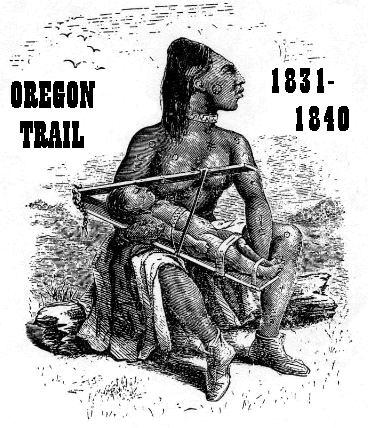
Birth on the Oregon Trail - 1850


Birth on the Oregon Trail
The Dalles, Oregon
October of 1850

Almost every woman who was part of a Wagon Train ,was in some stage of pregnancy or breastfeeding a baby.   Women could not vote, had no access to birth control and were expected to follow their husbands wherever they went.  

The river gave birth to the day, carrying the dreams, of those who traveled within her fertile waters. The mist drifted to meet the heavens, as the sun rose over the mountains to the east. A crescent moon lingered in the cold, clear skies.

The Grandmother had been born, in this place beside The Great River. They called the river, Thleyap Kamoon, after the mussels that grew in the water; the ones that were eaten on special feast days in the times before the wagons.

She sat facing east, as was her way in the morning.   

All summer she had watched the white men make their way up the hillsides to cut the pine trees; the trees that had watched over the village for all the time she could remember; home to her friends the coyote, the wolf and the bear.

 The trees became rafts for the wagons as they floated down the rivers and over the falls. Sometimes the wagons broke and their children drowned. They were strange little houses with wheels that they put on boats and sent down the river. She did not understand where they had come from and where they were going. She only knew that they took the trees with them.  Their soft green branches were left on the ground to fade and die and burn in their fires.

They came all summer.  More people than she had thought lived on the earth.  Just when it seemed that no more would come, these new ones arrived.  It was cold at night and she could see them shiver by their smoky fires; the women cooking while their children cried. She saw the worry in the face of the men, as they looked first at the sky and then the river.  The snows had already come to the mountain and so they had to go by the river.

She stood and tended her fire. Most of her village had been sent by the soldiers over the mountains to Warm Springs; a tribe that did not speak her language or knew the ways of the great river.  They had tried to protect their families from the moon-faced people who were killing their animals and destroying their forests but they had lost the battle and had been forced to retreat to the mountains.

It was in this time of half -light and dark silhouettes that she missed the old ways most. When the loneliness lingered and would not leave.

Tens of thousands of mothers and babies lost their homeland and often their lives,
as Wagon Trains made their way across and into their land.  Going west meant the promise of
"free" land for homesteaders.  The problem was that the land was not the
United States land to give away.   When ever one group of people is displaced for another, we can be sure
that we are hurting mothers and babies and threatening the culture that made a healthy,
sustainable life possible.  

Her tribe had been an important trading link between the Nez Pierce and coastal tribes. They had many feasts and ate the delicious mussels of the river.  This was the time when a bridge made by the gods crossed the river and there was harmony between the humans and the animals.

She had been born in these happy times.  In the time before the great diseases brought by the white men; in the time before smallpox and the measles.

Her father had been a French trapper with a face covered with hair like a bear. For this reason her forehead looked like the moon faced people and was not like the faces of her tribe. Her father had not allowed her mother to shape her head at birth, which had caused her great shame. Her father had told her mother she would be grateful one day, but the day had not yet come.  Because of her round head, the soldiers had let her stay here in the place where the singing creek came to the river. Maybe her father had seen these things coming in a dream.


She had not left with the rest of the tribe. She was too old and her place was there beside the river; in the place where the salmon returned from the sea.

Besides, she told herself, the new people would die without her small trading lodge and her grandsons to help guide their rafts down the river.

The French had named this place The Dalles because of the swift moving river and the high cliffs that nearly touched on either side.  They built a fort here and called it Fort Dalles. The wagons often stopped at the fort but others came to her to trade for food or a warm blanket.  They came here if they needed a guide to help them down the river.

 She was a woman wise in the ways of healing. Even those who lived there and did not take the rafts down the river came to her for herbs and to help their wives when they had their babies.

A doctor from the fort had come to see her and had told the translator to tell her that he was the doctor now and she should not give any more medicine to the white people. He would take care of them. She pretended not to understand him.

 Her grandmother had told her that hers was a gift that passed through her and was not hers to own or tuck away for winter. It was a gift of an abundant harvest and friendship. The old ones said they knew she would be a healer the first time she dug roots with them. That night they had made a feast for her – the little root girl with the round head and green eyes. She smiled recalling the pride of her mother and the warm tickling of her father’s beard. Her father was not like the other men of the village but she recalled the early days with happiness.  After that they let her learn the ways of helping women with birth.

A wagon was waiting to get on a raft in the morning. The mother had slept under the wagon with her young children. She was thin and as worn as the clothes she wore. Skinny, as she was, you could see that she was having a baby. She held her back as she looked out at the river.  Her husband had left with the cattle and the older children the day before.  She tried to start a fire with wet matches and green wood; the smoke covering her as her children cried with hunger.


“Use my fire. You will soon be gone down the river and have little time to make your own.”  She threw threw a branch on the fire and motioned for her to sit.

“Thank you. We left Missouri in April and were suppose to be here months ago.  I wish we had never set out on such a journey.”  She looked down so as not to let the Indian woman see her tears.

“My name is Margaret.” She added.

The Indian woman wished they had all stayed home too but ah, what was the point of such a wish.  This woman was soon to be having a baby and this land would be hers.   The French had not brought their women or children as these people did.  Some married Indian women and stayed, while others, like her father, went down the river and never returned.

“My father was French and named me Lizbet but the people here call me Grandmother.”

Margaret nodded, fatigue having not diminished her curiosity and desire for company.

 Lizbet who was known as Grandmother went in her lodge and returned with tea.

“These plants were given to us to help women with their births. “

Margaret from Missouri, alone save the company of three small children, drank the bitter tea warming her hands on the china cup and wondering about the woman who had left it behind.

She knew her new friend was watching her. Friend. This trip had taught her much about the nature of friendship.

 Friendships on the Oregon Trail were made over fires such as these. Friendships that lasted a few hours or for as long as fate allowed them to travel together
.
 She noticed for the first time the mist rising off the river and the colors of the hillsides that glowed golden with autumn and the morning sun. She knew she was pregnant when they left Missouri but her husband had assured her that she would have her baby in their new home, on their own land in Oregon.  With each wrong turn, each broken wheel, each river crossing and each death from cholera she knew that they would be fortunate to make the journey alive at all. She knew too that giving birth on the trail was dangerous. Babies were born too soon and too little and women were weak from traveling so soon after birth. Wagon trains tried to wait but with the threat of winter and starvation, most pressed on while mothers gritted their teeth in pain and babies cried.


A mother had died beside the Platte River. The women, with milk, took turns nursing the baby; passing the tiny bundle from wagon to wagon sharing what little milk they had to give from their own breasts till they reached the next fort where they left the baby.

Margaret remembered these things as she stared into the fire. Lizbet put her hand on Margaret’s stomach. It was hard. Margaret blushed. She had felt the pains coming all night but had no one to tell.  She had to get on the wagon.  She could not be in labor.

Her husband and the two oldest children had left with the cattle yesterday, walking along the river path. They would meet her today at the Cascades where a steamship would take them the rest of the way to Fort Vancouver.

“We can stay here for the winter,” he had told her.  “We don’t have to go on any more.” They had not ever been separated, even for a night and the worry was deep in his eyes as he set out.  She had watched until they were out of site; swallowed up by still another unknown trail.

“The baby won’t come till we are in the Willamette Valley on our own land.  Take the cattle and go. I’ll be fine.” She shooed him away with a weak laugh and a wave.  There had been a small spot of blood that morning. She knew from her other births, the baby would come soon now.

Margaret watched Lisbet turn the fish she was drying.

“The baby will be born before the noon meal.”   

 Margaret stood up and thanked her host. She would not listen to the foolish whispers of this woman.  She was not having her baby; not now. Please, not now.

“Not today, “ she replied as if stubbornness could change the future.

She left the fire and returned to her chores with determination. The wagon needed to be prepared for the trip down the river. What little they had left, would be needed to start their life in the Willamette Valley. Things would need to be tied down and covered to keep dry.  The baby would need to wait until Fort Vancouver where there were midwives and Hudson Bay doctors.

 Her back hurt but she told herself it was the result of sleeping on the ground in the cold.

As if she knew her thoughts, Lizbet came to her and began to speak and tell her about the river. How coyote made the falls so the salmon would come and bring her people food.

“The salmon are coming home to lay their eggs and then to die in the place of their ancestors. You will pass them on the river.” The old woman paused and touched the dry earth. “This is the land where my ancestors were born and were buried. You have left your mother and father to give birth with the salmon. It is a strange way to me.”

Margaret held back her tears recalling her parents and the joy of her life in Ohio with them.  Still she had no choice but to follow her husband and if need be, give birth alone without the care of women. She bit her lip and tasted her own blood, turning her head with pride and determination.

The men came and removed the wheels from the wagon after placing it on the raft with four other wagons. She searched for a familiar face but did not know these people who came from another company.  Lizbet walked beside her to the river and handed her a small blanket and in it a clean piece of string and a sharp, black rock.  “For your baby born like a salmon on the river.”

 Looking down with shame and confusion, she accepted the gift and walked with the children to the river and the waiting raft. She knew the old woman was watching her and knew that her waters had broken and were moving like the falls beneath her woolen dress. She only hoped no one could see.

Inside the wagon, Margaret put the children  on the bed. There would be no small boys falling from this raft. She pulled down one chair and put a piece of oilcloth upon it.  The pains would not be denied or stopped and she knew now that the Indian woman was right. She would have this baby on the Columbia River in a wagon on a raft.  It was her fifth baby so it would not be hard. 

“Go back to sleep. She ordered her children.  “Papa will be waiting when you wake up.”

“But Mama, we just woke up and we want to see the river. “

“ Shush. Put your heads under the blankets and sleep.”

 “Safer here than to be caught in the snow without a home for winter.  If a salmon can swim against the current all the way from the ocean to give birth in this river, well then she could too” Margaret whispered to herself between contractions.

“Are you alright, Mama?” The children looked on  from under their blankets, in fright, as she dropped to her knees with the next contraction.

“It’s just the baby.”

She tore off her woolen dress. It was all she had left and she would need it dry and clean when they arrived.   She unwrapped the things Lizbet had given her and reached for her bread bowl. Everything she needed was within her reach. The river was flowing fast.  Through a crack in the wagon cover she saw the banks of tress and cliff rush by. She looked out, trying hard to calm herself and not scare the children.  She took off her wet underthings and remained in her slip and petticoats.

The baby moved down further with small gushes of warm water and blood. She turned her back to the children peering from under their blankets and held onto the front of the wagon as she rocked back and forth.

It would be soon now.

“Dear God.”

She tried to hold back. To give herself another few minutes to calm herself and organize her thoughts but the pressure was too great. 

 Falling onto the chairs edge, she felt the stretching and burn, with only a second to reach down and catch the warm, wet baby before it hit the wagon floor. A small baby girl with eyes wide open grimaced and cried.   She sat back and laughed.  The children, on the bed, clapped.  They were all okay.

Margaret, balancing the baby on her lap, tied the cord in two places and cut it with the sharp piece of black rock that she had been given. She wrapped her baby in the soft skin of a deer and stood as the afterbirth slid onto the wagon floor with no time for the bread bowl. With the baby under one arm she scooped it up and put it in the bowl.

She tucked a clean cloth between her legs and slowly made her way to the bed where she laid the baby down with the other children.   She found a place beside them and nursed the baby.  The children, far to excited for sleep, were entertained by her stories of the salmon coming back up the river to lay their eggs in the exact places where they were born.   She told them of the cabin they were born in and of the people who loved them back home.  They were quiet with remembering and in that quiet fell to sleep.  The sound of the raftmen shouting and dragging the raft to shore work them.

 And then the voice of the Grandmother coming into the wagon to check on her and the baby.  She had known. She helped her onto shore where she had made a small shelter and had a fire waiting.
.
The men, who steered the raft, stopped their work and stared in disbelief. “ A baby. Never heard a sound.”

Her husband had to be steadied by the other men, so in shock he was.    

 A million questions floated through the branches of the cottonwood as their heart shaped leaves drifted to the ground.

The grandmother midwife stayed with Margaret and cooked her a stew of rabbit and bitter roots with herbs. She washed the baby and wrapped her well.

When the raft prepared to start out again she gave her a piece of her baby’s cord and told her to plant it on their new land so that the baby would love and care for that home.
Margaret held her baby in her arms as she tucked the piece of cord into her apron pocket.

The midwife placed her hand on the baby’s head and whispered a prayer in the language of her people.  She turned then and walked back down the path to her home; back to the place where the strangers entered the great river on the back of her ancestors, the trees. Back to the place where the salmon returned each fall, to the place where she had been born.


When I first came to Oregon, I was five months pregnant and did not know where we would live.  We drove across the country; following the Columbia River a long way before arriving in Portland.  I read in a museum, about a woman giving birth in a wagon while going down the river and how the people who were steering the boat never heard a thing.   There is a museum in the Dalles where the old trading post once was.  This is how I cam to write a story about giving birth on the Columbia River in a wagon train.  Birth stories gives us insight into the strength and resiliency of women while allowing us to understand the ways midwives have quietly cared for women for thousands of years. 

I always wonder if the women knew they were taking land from other women and their families, as they made their way across the country.  I know that many of them were immigrants, fleeing war and famine in Europe and most likely did not grasp the full implication of the situation.  I like to think that one mother would not knowingly hurt the children of another mother but I am not sure.  Then as now, governments wage war and make laws that hurt other people’s children in ways small and large. The people take part in these laws everyday without knowing the implication to others. In the congress of my country, I hear people raging on and on about “entitlements” and I think about all the land that was stolen and given to others and how that was the greatest “entitlement “ program of all times.  It does no good, for me a white woman, to criticize the mother in the wagon train, giving birth alone to her seventh baby.   This is my country’s story.  I come from these stories.  I cannot escape them.  As mothers and midwives, the birth and survival of every single baby is our deepest and most painfully, honest history.  They are not just the stories of birth but symbols of how our communities tended and disregarded its most vulnerable. 


Saturday, January 25, 2014

Birth of Juana Birones in 1802 / founding mother of San Francisco

The birth of Juana Birones as told to her by her midwife ( historical fiction)
Daughter of Maria Isadora Tapia and Marcos Barones
1802
Monterey Bay, Altos California


You ask me to tell you the story of your birth and of your mother.  Come Juana, walk with me and I will tell you this story.  I need to go to the mountains to dig roots for my medicine bag.  They are hard to find now and I will need your help.

You were born in a time of many changes. It was a time to help one another. It was a  time when more of my people were dying of the measles and smallpox than were being born. It was a time when our ways were dying  and a new way was being born.  This was the time you were born in.

Your mother, gone now from the sickness, was my friend.  She was an Indio from Mexico.   I remember the day she came to our land to build the mission and a new pueblo. I can still see your mother,  walking with her husband, Marcos, over the fields with your older brothers and sisters. They had a mule pulling a cart with all the things they owned. Your brother was riding a horse.  We did not use animals to help us with our work and we did not have the wheel so this was a strange site to us.

We were a peaceful people and did not know anything of war and colonial powers. We were curious and friendly. We had seen ships before but no one had ever come to stay amongst us or to build a pueblo. We had lived happily before the Spanish came.

Your mother was the daughter of a healer and had learned the way of plants from her mother who had learned it from her grandmother in the place they call Mexico.  Her mother was Indio; a different tribe than mine but Indio.  Her father was African and Spanish. He and your mother had not been treated well in that place.  The Spanish promised them many things if they walked all this way to help build the missions and make settlements for the king of Spain.

Your father had hoped to start a fine villa here for retired soldiers. But ah, their homes were nothing but sticks and mud. Always they tried to turn the dirt into walls but when it rained,the walls washed away and the roof leaked.

Because your mother, Maria, was my friend and willing to learn the ways of our people I taught her how to weave her walls with tule so that her home would be warm and dry. 

At the mission they made adobe bricks all day long. Always I saw the big hole with the mud and grasses and the little boys mixing it with their bare feet.  On the day you were born, your mother had sent your brothers to return the cows the family had borrowed from the priests. The mission did this. They gave you a cow until she had babies and you could start a herd of your own. On the day you were born they had their own herd and Maria wanted to return the mission cow. She said it would bring good fortune to the baby and sent Felipe and Gregorio with the cow.  When they got there they must have joined the other boys in mixing adobe. I know this because when they came to greet you, their feet and legs were covered with dry mud and grasses and your mother would not allow them to come in her house until they washed.

You were your mother’s sixth baby and her life was not so easy.  The villa had not turned out as she had hoped.  Instead of a model villa it became a place known for gambling and drinking and many bad things. Maria stayed mostly with us or went to the mission to help the Padre.  I felt much loneliness in her but she hid it with her gentle songs and fine sewing.

Now the mission has fallen down but back then it was new with gardens and cattle and a school for the boys. My own sons went to work there and in that way did not learn the old ways as they would have before the Spanish came. It was a sad time for me but ah, your mother loved the mission.

She also loved the wild plants and was eager to know everything about them. I was lonely for such a friend and took her with me into the hills and canyons.

I told her of our life before the sickness came and how we would all go together to gather seeds in the meadow. How delicious they tasted roasted in a basket that night for dinner.  How proud I had been as a young girl the first time I harvested the seeds of the meadow.

It was our way to burn the fields each year so we would have many seeds to harvest and so the elk and deer would come near our homes and be easy to hunt.

The Spanish did not want us to burn our fields anymore so it was hard to find seeds.  Maria tried to argue with her husband to let us burn the fields but he said the Spanish wanted the field for the horses whose hooves have taken away all the life of that place.

On the day you were born, Maria, your mother begged me to go with her out beyond the pueblo. She wanted to look for seeds and roots for our medicine bags.  She looked for quiet places as our pueblo was loud with soldiers, guns, animals and people shouting.

On the day you were born, the fog drifted away early, so we knew the seeds would be dry and fall easily into our baskets. We climbed high above our village and into the canyons. Although your mother was round like a great melon, we walked lightly and laughed like young girls.  We rested to watch the whales returning with their babies from Mexico. Your mother laughed and said, “They too traveled far to have their babies.”  We waved to them and watched them on their journey.

Later I teased her and said it was the sight of the mother whale with her young, that caused you to begin your birth journey. I watched my friends face. Her hands went to her round belly where she rested them and waited. I waited with her. When another did not come, she shrugged and we continued up the hillside to a place where we could see the Villa de Branciforte and the Mission Santa Cruz and the bay of Monterey.

We found a field my grandmother had shown me many years ago. It was not as good as the ones we burnt but it had, she said, the sweetest seeds of all.

We spoke of the world you would be born into. It was not a world either of us knew or understood but it was the one we were given. You moved a great deal.  We laughed and said you must want to see this lovely field and the baby whales. It was good in those times to be strong and curious and to laugh with a good friend.

The strong feelings of birth, were coming to your mother but the sun was warm and there were more seeds to gather. We used the special baskets of my mother’s; their weave so tight they could hold water.  The Spanish used pottery but it was never as strong as our baskets.

As we were talking and gathering seeds, a bear wondered over the hill and stared at us.   We backed slowly down the hillside keeping our eyes on the place the bear had gone until we were sure we were safe.

At this time you became very impatient. You had not seen the whales or the bear or the special field where the seeds still grow.  You wanted to see the world for yourself and though we spoke to you in cooing and calming ways all the way home, you were strong and impatient. Your mother was barely able to stand straight and often had to lean on me for strength.

When we came near the villa the people could see that you were ready to be born. I sent for someone to go to my house and get my bags and another person to get Marcos who had become a comisiando and was trying to enforce the laws of the villa.

Maria and I were still recovering from fright of the bear and were all of a sudden overcome with relief and laughter.

Your home was cozy and warm with the skins of many animals as well as the blankets from the mission. and a few kitchen items. Marcos rushed in after us and soon your grandmother joined us.  I ordered everyone around like a solider in the Spanish army.  “Make a fire.  Heat the rocks for the water.  Get out the best rabbit skin and find my obsidian rock for the cord.”

The women of the pueblo gathered outside, under the shade of the arbor.  They wanted to come in as was our custom but your mother was not accustomed to so many people watching her give birth.

The excitement of a birth is the best kind of busy.  We could tell by your mother’s breath that the time was very near.  Her eyes were black and looked towards me for reassurance. Her hair was still wet from climbing the mountain and it fell gently over her face. Your mother was a beautiful woman.

Your grandmother held your mother gently in her arms so she could bring her body down near the earth. Her great feet that had walked all the ways from Mexico were flat upon the dirt floor.  Her hands gripped her mother’s.  I lifted her dress modestly above her knees and began my silent prayers.

Marcos lit candles and filled the small room with light. It was a gift from the Padre. So many candles I have never seen for a baby’s birth.

Your older sister, Guadalup, brought me warm water in a basket. I put the birth herbs in there. Their smell filled the room. Gently I covered her legs with this warm water and in time her own water filled the room, mixing with the smells of the plants and the warm wax of the candles.

I wet her mouth gently with sweet water from the spring.

It was silent save for Mariah’s breath and then with a low groan she moved ever so slightly, released her mothers hands and reached down to catch you in her own hands. 

You did not cry but looked at us and your home with determination and curiosity I remember even today. You
were born with the spirit of the bear.

Your mother, tired then, laid down and began to let you nurse. The boys came in with their muddy feet. Everyone laughed and the silence was broken. Marcos said it was time for a fiesta.

It was a time of few births in our pueblo so everyone was very happy.

Your grandmother burned the placenta, as was our way. She threw the ashes in a sacred place for good luck.

I became bossy again and made everyone leave while I cut the cord with the obsidian rock and tied the cord with the sinew of the deer.  Your grandmother brought your mother a warm broth.  Your father, Marcos, came in and sat beside you as the tallow candles slowly burned down and you slept once again.

While I was busy cleaning your home and gathering my things I heard your father say this to your mother.

“I have never given you the Rancho I promised you when I married you but my children and you are all the riches I need. You are more precious than all the gold of California.”

Then he leaned down and kissed you, his new daughter.
.
Yes, Juana, I remember your Mama and the day you were born and the place where there are still seeds to gather. The place where we saw the whales and the bear on the day you were born. I will show you now so you will remember.

Juana was born in 1802.  In her life time Mexico would gain its freedom from Spain. The place they called Altos California would, for a few brief days be its own republic, before becoming part of the United States.  The mission system, which caused the death of her midwives people, ended when she was thirty.  Gold would be discovered, bringing thousands of people to this land. Juana, born in the midst of so much change, was as strong as her mother and midwife predicted.   Although she became a prosperous business woman and land owner, she never forgot the lessons of her mother and was known as a healer and midwife to all she knew.  Although her father never owned the Ranch he dreamed of, Juana worked hard and came to own several ranches. One of them is in present day San Francisco; the city she is honored now for helping to establish.