Wednesday, April 13, 2016

The Last Time I Saw Haiti - James Audubon

The last time I saw Haiti
                        James John Audubon


Birthplace of John Audubon ,as it might have looked to him, as he sailed away as a child.

Each evening, I was rocked to sleep by the music of my country.  It was as familiar to me as the sound of the sea and the rooster and the bird that wished me good morning.   In the day, when I tried to pay attention to my lessons, there were the songs of work, both in the house and fields and the bird in the tree.  If the facts of my childhood have blurred with time and history, the sounds of its people and the songs of the birds have not.    I was born on the southern coast of Haiti; home to the Taino Indians who lived near us and taught us all how to survive in a place foreign to us all.   My father called the land Saint -Domingue but the people called it Haiti.  I lived on a sugar plantation near a small port the French named Les Cayes.     Boats from France brought us many things and then my father loaded the ships with coffee and sugar cane from our plantation.  

There was drumming at night.  My father loved the drumming.  We would sit by a fire outside and listen.  My brothers and sisters would dance and our mother would make us ginger tea with sugar.   If my father’s friends came over, he dressed up and only spoke French but when it was just we, we laughed and told stories and were barefoot.

 Some said my father had grown wild and uncivilized from life on our island.  They encouraged him to leave the plantation and return to France.   I heard a man say he did not know how to keep his distance from the Africans.  This was true because the woman who I called mother and her children and all our friends were the many shades of brown.  

The woman who raised me, as her own said if he ever whipped a slave she would cut his throat in the middle of the night. He laughed but he also didn’t whip slaves.  Some people said he let a woman run his life.   He had a weakness for loving women and it didn’t seem he cared what color they were.

The mother who gave birth to me, died when I was a baby and so my next mother took me to her breast and saved me.  The woman who nursed me said only this. “ Your mother was very beautiful. Her skin was the rich color of coffee with milk in it.”   She was Creole and your father brought her home from Louisiana.    She loved you and then she died of the fever and there is no more to tell. “

I asked what is Creole and what is Louisiana as these were all I knew about my birth Mamma. 

“Creole is the sun shining in the sea. It’s African and Spanish and Indian and a little French.  Its all the beautiful landed right inside of you.” 

And that’s all they would tell me ever about her.”


 My father was always happy when my new Mama was near by.   She had babies near every year and we all said each one was cuter and healthier than the last. 

We had lessons in French everyday, but mostly we played and went fishing and I filled my schoolbooks with drawings of things I discovered as we played. 

When my father landed in Les Cayes, and rode to our plantation, he found the overseer had died and the slaves were pretty much running it themselves.   They had their own villages and gardens and farms and doctors and even priests.  My father said they were not real Catholic priests but some sort of mix of Africa and Catholic.   They spoke a language my father never heard of; just like the religion a mix of Africa and Taino and French.    As long as they made enough profit to pay for expenses and send a little to France, he let the plantation be as it was when he arrived.  

 When we went to Les Cayes I saw them whip the new people who were arriving from Africa. I saw a man hanging dead in front of the church.   My father said he had run away and so they took his life.  When I got home, I drew a picture of the dead man and then next to it a picture of the man alive.   I said to my father, “Look I made him come alive again.”   He threw it in the fire and said a drawing can never make a dead thing alive again and sat for a long time with his head in his hands until I crept into his lap and hugged him to me.

 One night the drumming lasted all night long and when we woke up the plantation nearest to us was on fire.   Some of the slaves came to see my father and they talked a long time.  I could hear my mother crying.   We all sat outside the door and listened even thought we knew it would be trouble if the door opened and we were there. 

“Master, there is no choice.   You and James have to leave.   We’ll make sure you get out safe and the boy unharmed but you gotta go, sir.”

Go where?   This was my home.   I knew I had family in a place called France but I did not ever want to go there.  Never.


We heard our father say he would never leave our mother and his children. He’d stay and fight.   But it was no use.  Our mother cried and said she’d be fine.   Besides she told him, “ She was siding with freedom and it wasn’t going to be a safe place for any white people.”

“Even if it means we can’t be together and we loose our land and all we love.”

“God knows I love you and all the children you gave me but nothing is worth more than freedom. Nothing is stopping freedom in Haiti.  I love you but you have to go.  Go make freedom in France. None of us can’t live free while others are slaves. “

“You are free.” My father argued.  You never were a slave.’

“I know but I can’t live side by side with slavery. “

A voice interrupted them.  “We need to go tonight. There’s a ship headed to France.  We’ll row you out.”

“I’ll take everyone.  We’ll all go then.”

“Just you and the boy.”

I ran then to the barns and hid out there.   I heard them calling me.   Old Audubon, my favorite slave, called me with our special birdcall. Finally I came out and put my head in his lap and cried.  

“I’ll run away and be a maroon and live with the Taino in a cave.  I will.  I will.”

He laughed and said the maroons didn’t much need a boy to help fight a revolution.” 

“Do you want a revolution?” I asked him.

“I want to be free, like everyone.” 

“But what about me?”

“You are going to France and will get a fine education and sail in a big boat. That will be an adventure for you.”

“No, you are my teacher.  You taught me all the birds and their calls and where to find their nests. You are my best teacher. “

He took out a small mahogany bird and pressed it into my hands.   ‘There are birds everywhere.”

Then my father came and shook me and said we were leaving.   It was dark and the drumming had begun again.   He had a bag packed for us and we were taking a path down to the sea.  It was a trail we had taken often when we went to the beach but it was dark and there was no moon.    We hid by the firestones; the place where we cooked fish and lobster and swam all afternoon.   It was the most beautiful place in the world.

When we got to the sea, a mango canoe was waiting and the slaves who had walked with us, held me tight.   They had taken care of me all my life.   I was scared now and clung to them.    

“We can’t be found helping a white man escape.” they told my father.  

Just then my mother burst through the underbrush with my sister, Rose. 

“Take her too.  Take Rose.”  

She did not wait but made off from where she had come.  There was no time to wait and so we took Rose too.  She was my younger sister and I was glad to have at least one of my family coming with me.

The two, who came with us, rowed us out to the ship.  It was quiet; only the sounds of drumming and singing up in the mountains to bid us good-bye.  Not even my mother or my sisters and brothers.    They were already gone. 

“Can we come back?  Please. When everyone’s free can I come back?”   But no one said anything.  Only the oars in the sea and then arms lifting me into the ship and the canoe slipping back into the dark.  

My father made us a bed and we lay down and watched the clouds disappear and the night grow bright with stars.   We were woken by shouts and a great fire which was our plantation burning.   My father put his head on the ship’s rail and cried.   The ship slowly pulled away.


The ships deck held a cage of birds that were worth a lot of money in France.  

“They want to be free too.” I said in a whisper.  They want to stay in Haiti too.   I opened the cage and watched the birds rise and fly back to shore.  The sky was filled with fire and smoke.

I watched my homeland slip into the darkness; a silhouette of greens glowing wit fire.  I stood there for a long time; watching her slip away. 

Then my father put a hand on my shoulder and said sternly, “It is done.  You are French and you must never speak of your mother or your family.  They are dead to us.  We two will know they live; that they eat mangoes and coconuts and swim in the sea, but we will never speak of them again.  We are French.  No more Creole. No climbing tees to look at birds nests.  We will live in the city.   Never tell anyone about your life here.   We will say your mother was French and that you are white.  No one can ever know where you came from.  The world is not kind.”

“But my brothers and sisters?” 

“They are taken from us.”


We passed a small island off the coast   we passed fisherman who waved and called a hello.   We stayed there on the deck, until it was only the sea all around us.  My father kept us out of the sun so our skin would grow pale.   He worked for hours to straighten our hair and our change our speech. 

After a long voyage we arrived in Pairs.  I was punished if I ever spoke Creole. My father said I was his only son and that my mother had been the daughter of a French plantation owner who had died at my birth.   I was never allowed to speak of Haiti again.

When Haiti won the revolution I hoped we could return but my father had reunited with his French wife and she knew nothing of our life in Haiti.   The French sent another army to fight and try to win Haiti back but they lost again and my Haiti was free forever.   My father talked about all the money he lost but he never talked about the family we lost. My new mother ran her hands through Rose’s and my hair.   I think she knew but she was a loving woman and a good mother to us. 

In Haiti, they said, when we die we return to the place of our birth.  They want to go home to Africa but me I only want to return to. Haiti. In my dreams, I see Haiti as she slipped from view that last morning and I know when I die, I will return to Haiti and the sea and the birds and my brothers and sisters.  We will catch many fish and lobster and make a fire on the beach and listen to the drums as the stars come out – just as it was the last time I saw Haiti.


Postscript
When I was in Haiti, I visited LesCayes and thought of the young James Audubon as he sailed away from everything he knew, to start a new life in France.   He later said that he was not allowed to speak of his origins in Haiti.  Biographers wondered if he feared people would see something of Haiti in his eyes or hair or skin; things that would hurt his family and career.  I think of the woman who gave birth to him, the woman who nursed him and the woman who adopted him.  I consider the fates of his brothers and sisters left behind during the revolution and how they survived those times.  .  I think of the many people who forced him to “pass” as white, then and now, the many people who refuse to say,  “Ah yes, Audubon – the famous naturalist and artist from Haiti.  ”  


I


Sunday, April 10, 2016

Emptying the Catheter Bag - lessons of the heart.

Emptying the Catheter Bags


 Learning and writing about the many ways women in Haiti work together in an ancient network of survival and dignity within a community of friends and family.


I am slowly moving up and down the rows of beds in the hospital.  It is late afternoon and there are few midwives to manage the three busy antepartum, postpartum and post surgical rooms.   There are no machines or beeps or signals when things go terrible wrong.  Just three midwives for the three rooms as well as the labor and delivery area.   Earlier in the day, the rooms are over flowing with students, preceptors and midwives.   By five it is quiet and it is then that the families take over the care and management of the rooms.  


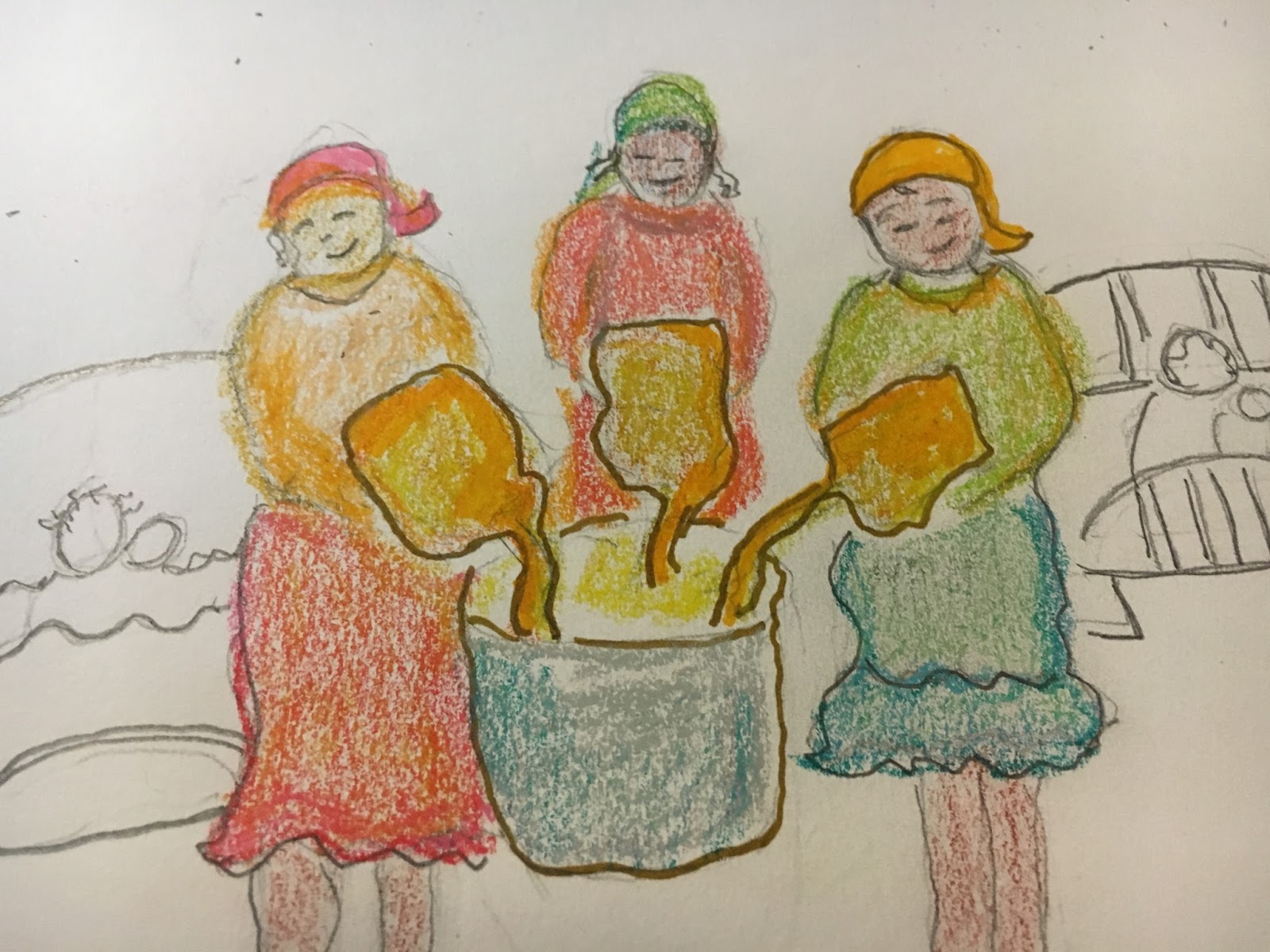
From my sketchbook - Women emptying catheter bags together 


They give advice and offer support.   An elderly man moves form bed to bed, offering words, if not medicine.   I take vitals and write them on a chart I make; circling things that are abnormal.   

The rooms are full of women with catheter bags hanging from women.  It could be a post c-section woman or a woman who is pre-eclamptic and was given magnesium sulphate.  The bags hang from the beds and are almost always full of urine.   The ability to urinate is a critical sign of well being as well as an indicator of advancing disease.   The bags are a measuring cup of urine with lines indicating the volume of urine.  It is suppose to be charted and noted.   But there are not enough midwives or not a clear enough understanding of why it is important to empty them and write down the findings.  I am not sure which or if the two blend together in a relaxed state of neglect.  The blood pressures soar.

I am doing this rhythmically in an attempt at order.  I breathe and tell myself to stay in the present moment.  It is one two hours.   Blood pressure, pule, temperature, amount blood loss, listen to babies, Listen to stories and record my findings.   

The mothers are often attended by their mothers; elderly women from the countryside who sit by their daughters' beds and care for them as if they were at home.   They feed, clean and offer sips of tampico.   They laugh and visit with one another.  

Selfie with a woman who comes to help her daughter at the hospital


And then I look over and done woman is examining a very full urine bag.   I am thinking of the film, The Gods Must Be Crazy.   Another women joins her.  How does it work?   They seem to understand that they are all full and that they need to be emptied.   Do they understand that the urine has no where to go after awhile and it will hurt or could cause infection, regardless of its original purpose?

One woman gets a bucket.  She has figured out the mechanism and empties one bag.  Then other women joiner and they slowly make their way to every bed and empty every catheter bag.   The bucket fills up and the bags collapse and hang empty from their owners.   

After they finish, they carry the bucket outside and return with it empty.   The bucket is turned over and becomes a seat.   Everyone settles back in and sits beside their loved ones beds.   

I am pretty sure they were never given an opportunity to get much of an education in a country in which the ruling class has determined that one can only value an education you pay for.   In the absence of a formal education, they grow wise and kind and funny. They are no nonsense practical and love without any expectation of reward.   The strange bags they are suppose to pee in simple must be emptied.  And so they are.

They help each other.  They are wearing their best clothes.  I smile from my dirt soaked toes to the top of my matted, dust woven head.   When I grow up ( I am nearly 68) I want to be them.   I want to be that smart, that kind and that willing to work with others - not because of any outcome - but just because it needed to be done.  

I strongly suspect that they , like me, think it is much easier and safer to simple pee into the bucket in the first place.  I always got women up to pee in labor.  It emptied the badder to allow more room for the birth and it got the woman sitting on the toilet.  It prevented bleeding.   It got the baby into a better position.  "Go pee and have a few contractions on the toilet, " I said to hundreds of women in labor, as  they wrapped their hands around my head and cried into my hair.   

We laugh and shrug.   

Friday, March 18, 2016

Daylights savings in Haiti


 Learning and writing about the many ways women in Haiti work together in an ancient network of survival and dignity within a community of friends and family. 


On Saturday night, coming back from a walk to see the sunset, we reminded ourselves about the time change the next day.  But when Sunday came, the big news was that the interim president had decided to not follow the daylight's savings time change.  It seems the last president had declared Haiti would follow day lights saving but this president has said, "no."

"What time is it?"
"This president's time or the last president's time?"

Still most people, rise before the sun and walk to their gardens or to the markets or to school with no regard to clocks. The roosters crow with increasing intensity as dawn spreads across Haiti.   Life proceeds within an ancient dance of dawn and dusk with no regard to the debate over daylights savings and US time.

We hear singing and the sweeping of the yard.  Children walk to collect water.  Animals are led to market.  The women call to each other on the road.

I ask the students, at the midwifery school, who all arrive at different times, what they think.  I explain why the US has daylights savings to help the farmers.

"The farmers work when it is cool here.  They get up in the dark and are finished by the time it is hot."

"You cannot save daylight, like its money."

I see.

I too, get up in the cool, dark of early morning.  Apple is suppose to change our phones and computers for us but they cannot keep up with Haiti's presidential elections and decrees and so they stick to US time.   The clocks break.

Within this,  we all keep moving through day and night and dawn and dusk.   I try to feel time, like I imagine the women do; in the sounds and in the touch of my skin and in the way the air smells.   I sleep outside so I can feel and hear the time.

A person I met says, it is not that the women want to live outside of time and clocks.  They have no choice so they create, within the structure they are given.   It is brilliant, she agrees.  But it is brilliance born of repression and necessity and not choice.

I wonder if brilliance, born of necessity, is any less brilliant or does it shine brighter for its journey.  

Sunday, March 13, 2016

Where women go to pray


"Where two or more are gathered in my name."  


At dusk, the women of Haiti, climb Prayer Hills where they sing and pray in small groups or by themselves.
This simple chapel was built on such a hill.  They may not have he clothes, necessary to attend church on Sunday but they make their own places of prayer.  

Friday, March 11, 2016

International Women's Day


International Women’s Day

It is Women’s Day.    Partners in Health makes large, plastic banners, in partnership with the health department and displays them in front of buildings and strings them across the street.    The women carrying food to market, unable to read, pass beneath them.  Young girls herd goats or carry water; unable to pay the tuition for school.   It’s Women’s Day in Haiti.

At the hospital a fourteen year old is diagnosed with HIV, syphilis, genital warts and possibly TB.   She is pregnant and wearing a nightgown that hangs from her shoulders in shreds.    They have discharged her because she has a cough and they believe it is TB.  They won’t treat the HIV or syphilis because she is alone, without family.  That is the rule.   After being discharged, she sleeps on a hospital bench so she wll not be raped again and again. 

It's Women's Day in Haiti


I do not give up.  

Anyone who might help me is at the Women’s Day Party, across the parking lot.   They have bright new t-shirts and are being given lunch.    The maternal health wing staff have migrated over there.   We buy her food and a Tampico and water.  

I am told that if she had TB, maybe they would let her sleep over there.  But, sad to say, there are no more TB tests.  I walk out back and find one and she spits into cups.  If she has TB, we can get her a bed and perhaps treatment for her HIV and syphilis and a safe place to sleep. 

It’s Women’s Day in Haiti, so it is a hard problem to solve. People are busy. I do not want a t-shirt. I want a bed for this young, sick girl.  They say she is not sick.  I say she has HIV, syphilis, was raped, is pregnant and possibly has TB.  How sick does one does have to get.   Oh and genital warts and severe malnutrition.  

“She is crazy.”  

“Maybe we’d all be crazy if we were raped and dumped in a strange town.”   

The translator looks up and says,  “Welcome to Haiti.”   Now can she go and get her free t-shirt. 

Finally, it is agreed that she can sleep on the triage table in a hall for a few hours.   We settle her in and put a portable curtain I dig out of a supply room, around her. 

Wen I return to check on her, she is gone.  I panic, but  then there  she is braiding someone’s hair in the soft, afternoon sunlight.    She has nothing but the shopping bag we have filled with a few items but still she offers to do what women do – braid each other’s hair. 

I watch this single, powerful act of solidarity.  I watch her divide her new friends hair into small strands and twist and turn and braid.  I watch this powerful act of sisterhood; this powerful act of belonging. 

It’s Women’s Day in Haiti.
I watch this single, powerful act of solidarity.  I watch her divide her new friends hair into small strands and twist and turn and braid.  I watch this powerful act of sisterhood; this powerful act of belonging.  

It’s Women’s Day in Haiti.


Sunday, March 6, 2016

Maroon Women - their lasting lessons about self sufficiency and freedom


The Maroons


Add caption statue dedicated to a marooon woman who was hung the day after she gave birth.    


Did you remember this book?  You looked at a picture and it looked like one thing but when you looked more closely it was something else. If you looked beyond and into the picture’s details, your eyes focused on something else entirely different from your first impression.

You began to understand.   You began to see what was disguised.   Here we see “poverty” but then, over time, our vision clears and we see something else so profound and so remarkable its wisdom takes our breath away.

Such is the way of my Haiti sheroes, the Maroon Women.    Drug and imprisoned in the native Africa and brought to a plantation in the Caribbean, they found ways to run away or to support the Maroon communities in the mountains.  In the mountains, they met Amerindian women and together they created a new society, a new language and from their self-sufficient communities, they fought a covert was for freedom.  There were more men than women and often the women stayed at the plantations, to help with complicated plots of sabotage and gathering supplies.  

These women were healers and farmers and mothers.   They were abused and raped and beaten and enslaved until one day they slipped away, despite the dangers of being caught, and lived the life of a maroon. 

Nanny- famous maroon healer in Jamaica


From the time, the first African joined the first Amerindian in a cave or small, hidden ravine; they knew they loved freedom more than fear of death or a lack of material things.  

The first building block was their lives in Africa and in life, before Columbus.  The second building block was all they learned from the Spanish and French who invaded their island and brought them there to be slaves.    They took all these lessons and became Maroons.  Some ran away from the plantations and others supported the movement from within but the goal was a new society based on a self-sufficient ability to live on the land and never, ever return to the plantation. 

When I look closer, I no longer see poverty.  I see a brilliant determination to be self-sufficient.    The elite of Haiti, along with their US partners, try to get them to return to the plantation but they are sons and daughters of the maroons and they resist even today. 

Ah – the ships that arrive to this land take many, many forms over many years.    If they wanted to break their spirits, once and for all, they had to take away their ability to live self sufficiently.   They had to create dependency.     

But this morning, I am rooting for the maroons all over the Caribbean. But I am also rooting for the maroon in all of us.   The part of us that is willing to create, new communities, to live simply, to create new ways of communicating and say no to the “plantations” in our own lives who seek to burden us with debt and the use of things we do not need.   


Many years have passed since the first maroon communities were formed in Haiti and Jamaica and Florida, but that spirit lives on. In my work, I see the plantation of the elite and the plantation of NGO’s and the “church” but I also see the maroon.

A small group of midwives comes to me and says we want to start our own birth homes’ simple backyard birthing rooms for their communities.    I watch them as they watch me.   I do crazy things like make them write a mission statement and goals and a timeline and budget.  I feel I have to teach this so they can survive. 

I help a student catch her first baby.   I take vitals and try to be a creative fun teacher.   I try to teach to stop eclamptic seizures.  I do these things.

But I am thinking about maroons and the maroon in all of us.    The maroon in me loves the maroon in you.   Sometimes, I wish I were different.  I wish that this spirit were not so strong in
Me. I think of sitting in meetings and pulling a mask down over my face and then running for the woods, as fast as I could when the meeting was over.  

Thank you to all the maroons for all the sacrifices for freedom and all the lessons you continue to teach today.  You are my International Women’s Day Sheroes.